

How Is AI Motion Different from a Conventional Forklift AI Camera System?
AI camera systems for forklifts can detect pedestrians around the vehicle and warn the operator when a person enters a risk area. However, when the system is required to do more than provide a warning — and must automatically slow down or stop the forklift — the method used to control the vehicle becomes an important part of the system.
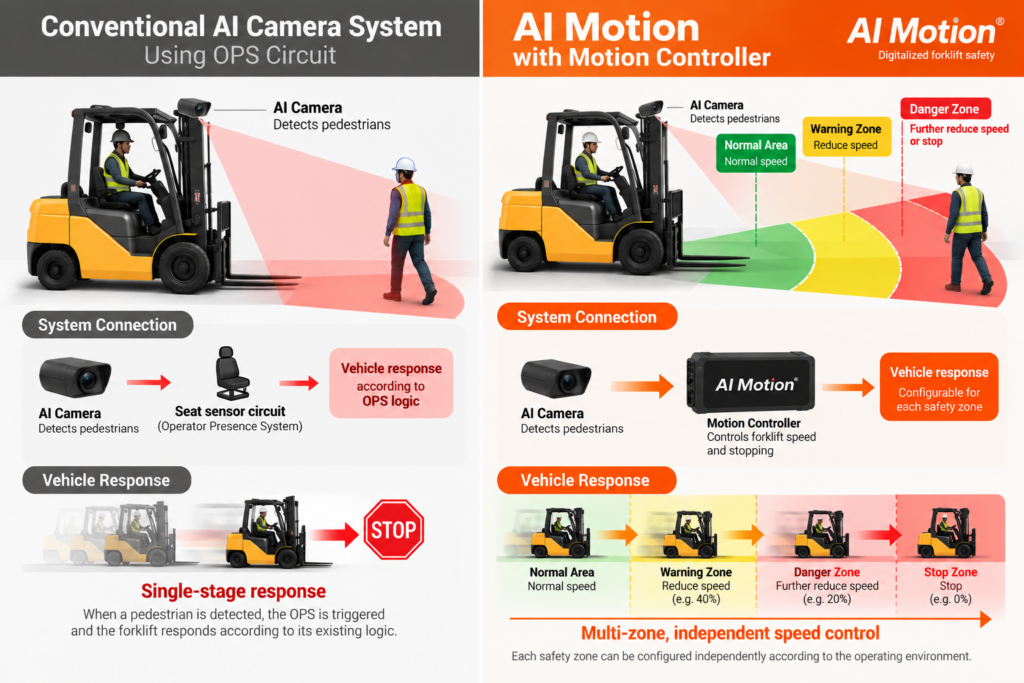
Some systems use the signal from an AI camera to interrupt or interface with the forklift seat sensor circuit, causing the vehicle’s Operator Presence System (OPS) to respond.
AI Motion from Quick Autopart takes a different approach. It separates pedestrian detection from vehicle control and uses a dedicated Motion Controller to manage automatic forklift slowdown and stopping.
AI Camera Handles Pedestrian Detection
The primary function of an AI camera is to detect pedestrians around the forklift.
Detection zones can be configured according to distance and operating conditions, such as a Warning Zone and a Danger Zone. When a pedestrian is detected, the camera sends a signal corresponding to the detected zone.
If the application only requires an audible or visual warning, the process can end with an alarm.
But when automatic vehicle response is required, another question becomes important:
Once the AI camera detects a pedestrian, how does the system actually make the forklift slow down or stop?
This is where the system architecture becomes different.
Using the OPS Circuit to Control the Forklift
An Operator Presence System (OPS) is a forklift safety system that monitors whether the operator is in the operating position. The exact functions and vehicle response can vary depending on the forklift manufacturer and model.
Some AI camera systems connect the detection signal to the seat sensor circuit so that the forklift responds through its existing OPS.
The limitation of this approach is that the AI system is triggering an existing vehicle safety function. The resulting response therefore follows the logic already built into the forklift’s OPS.
In practical terms:
Pedestrian detected → OPS condition triggered → Forklift responds according to its existing OPS logic
This provides essentially a single-stage response from the detection signal. It is not designed to independently determine how much the forklift should slow down in one detection zone and how much further it should slow down in another.
AI Motion Uses a Motion Controller
AI Motion separates Detection from Vehicle Control.
The AI camera detects pedestrians, while the Motion Controller receives the detection signals and controls how the forklift responds.
The important difference is that the Motion Controller is not limited to a single on/off response.
It can independently configure the level of speed reduction for each Safety Zone.
For example, an application may be configured so that:
- Normal area: forklift operates at normal speed
- Warning Zone: acceleration is limited or forklift speed is reduced to a configured level
- Danger Zone: speed is reduced further or the forklift is commanded to stop
The speed-control setting for each zone can be configured independently according to the operating environment.
This means that detecting a pedestrian at different distances does not have to produce the same vehicle response.
From a Single-Stage Response to Controlled Deceleration
This is one of the key differences between triggering a forklift’s OPS and using the Motion Controller.
When an AI camera interfaces with the OPS circuit, the vehicle responds according to the existing OPS logic when the condition is triggered.
The Motion Controller, on the other hand, is designed to control forklift movement according to different levels of risk.
Instead of only creating a single response, the system can progressively reduce forklift speed as the risk increases.
For example, when a pedestrian first enters the Warning Zone, the forklift can remain operational at a reduced speed. If the pedestrian moves closer and enters the Danger Zone, the system can reduce the speed further or command the forklift to stop.
The objective is therefore not simply to “stop the forklift when a pedestrian is detected.”
The system determines how the forklift should respond at each level of risk.
Detection and Vehicle Control Are Different Functions
Separating these two functions also means that the Motion Controller does not have to work exclusively with an AI camera.
The Motion Controller can receive signals from different detection technologies, including AI Camera, UWB and Ultrasonic sensors, and use those signals as conditions for vehicle control.
This allows the detection technology to be selected according to what needs to be detected, while the slowdown and stopping behavior can be configured according to the actual operating risk.
For example:
AI Camera can be used for pedestrian detection.
UWB can be used for tag-based proximity detection or defined safety zones.
Ultrasonic sensors can be used for short-range obstacle detection.
These detection technologies can provide inputs to the Motion Controller, which then determines the appropriate forklift response.
Why AI Motion Is More Than an AI Camera with an Automatic Stop Function
AI Motion does not require the AI camera to perform both detection and vehicle control.
The AI camera answers:
“Is a pedestrian present in the risk area?”
The Motion Controller then answers:
“How should the forklift respond to that level of risk?”
Separating these functions allows Safety Zones and speed-reduction levels to be configured independently according to the actual application.
One area may require only moderate speed reduction. Another may require a greater reduction in speed. The closest Danger Zone can be configured to stop the forklift.
This is the core concept behind AI Motion:
Detect the risk, then control forklift movement according to the level of that risk.
The Motion Controller was developed by Quick Autopart Co., Ltd. A Thai petty patent application has been filed for the Motion Controller as an automatic forklift speed-reduction device designed to reduce collision risk.