


The Blind Spot Behind a Container: When a Forklift Reverses Into a Pedestrian
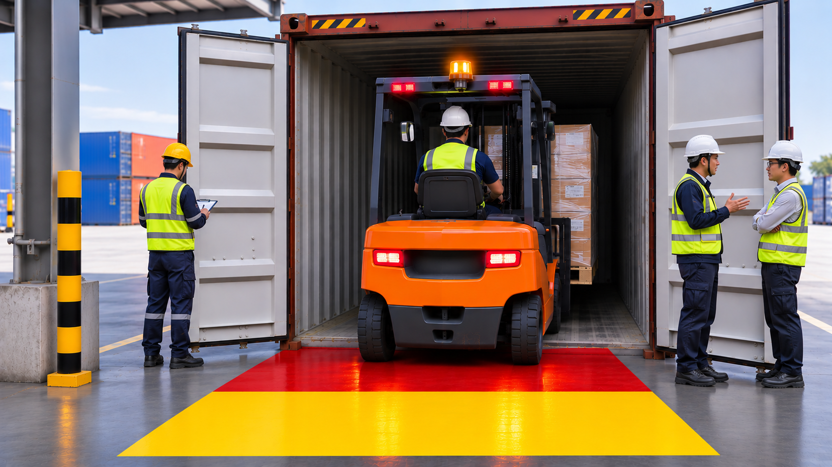
The operator is watching the load. Workers are standing beside the container door. Both are doing their jobs, but neither may see the danger developing.
A routine unloading operation with an overlooked risk
Consider a common situation at a logistics warehouse.
A forklift enters a shipping container to collect a pallet. The operator focuses on positioning the forks, lifting the load and carefully reversing through the container opening.
Outside, another worker is checking cargo or preparing the next pallet near the container door.
The container walls restrict visibility. The operator may be looking over one shoulder while controlling the vehicle, and the worker may be facing away from the forklift.
As the forklift reverses, the rear of the vehicle approaches the worker.
A reversing alarm may already be sounding. But in a busy loading area, surrounded by trucks, machinery and other activities, an alarm does not guarantee that the worker will move or that the operator will react in time.
The critical question is not simply whether the forklift has a warning device.
It is whether the forklift can respond when someone enters its reversing path.
Why container loading presents a different safety challenge
Unlike an open warehouse aisle, container operations create several overlapping risks.
The container opening forms a restricted passage. The operator’s attention is divided between the load, the vehicle and the surrounding area. Workers may be positioned close to the doorway, and the forklift’s rearward visibility can be limited.
Even when site procedures require pedestrians to remain clear of the operating area, an unexpected movement or moment of distraction can create a dangerous situation.
Traditional safety equipment remains important, but each device has limitations.
A reversing alarm informs people that the vehicle is moving. A warning light makes the vehicle more visible. A camera monitor helps the operator see areas that may otherwise be hidden.
None of these devices, on its own, guarantees that the forklift will slow down or stop when a pedestrian enters the danger zone.
This is where automatic vehicle response becomes relevant.
From pedestrian detection to automatic intervention
Quick Autopart’s AI Motion system uses an AI camera connected to a motion controller to detect pedestrians and trigger a configured vehicle response.
Instead of treating every detection as the same level of risk, the system can use different detection zones.
Pedestrian detection
The AI camera monitors the designated area behind the forklift and identifies people within its detection field.
Yellow zone — Automatic slowdown
When a pedestrian enters the warning zone, the controller commands the forklift to reduce speed.
Red zone — Automatic stop
When a pedestrian enters the danger zone, the controller commands the forklift to stop.
The benefit is that the system does not depend entirely on the operator noticing a warning and initiating braking.
However, a stop command is not the same as an instantaneous stop. Actual stopping distance depends on vehicle speed, load, braking capability, floor conditions and the forklift’s control system.
The detection zones and braking response must therefore be validated on the actual vehicle under representative operating conditions.
What about pallets, container walls and other objects?
The same forklift may also reverse close to stacked goods, dock structures or other obstacles.
But detecting a person and measuring distance to an object are different tasks.
An Ultrasonic Sensor can be installed at the rear of the forklift to detect nearby obstacles and provide distance-based audible warnings.
As the forklift approaches an object, the warning becomes more frequent.
This can help operators when reversing near pallets, walls or other equipment.
For a forklift working around shipping containers, the two technologies can complement each other:
| Risk | Suitable technology | Response |
|---|---|---|
| Pedestrian behind the forklift | AI Motion | Automatic slowdown or stop |
| Pallet or obstacle behind the forklift | Ultrasonic Sensor | Distance-based audible warning |
| Another tagged vehicle approaching a shared route | UWB | Configured slowdown |
| Tagged blind-corner location | UWB | Configured warning |
UWB is useful in applications where tagged people, vehicles or infrastructure locations need different responses. It does not automatically detect every untagged person or object.
These technologies should be selected according to the site’s operating conditions rather than installed indiscriminately.
The real challenge is choosing the right response
A warehouse may have several different accident scenarios within the same loading area.
A pedestrian entering a reversing path presents a different risk from a forklift approaching a pallet stack.
A vehicle approaching another forklift at an intersection may require a different response from a forklift entering a restricted pedestrian area.
Applying the same warning or stop command to every situation may create unnecessary interruptions without adequately addressing the most serious risks.
A better approach is to identify the hazard first, then determine whether the appropriate response is a warning, speed reduction or automatic stop.
Before installing a system, examine the actual operation
For container loading and unloading, a practical safety assessment should consider where workers stand, how forklifts enter and exit containers, whether pedestrians can enter the reversing path, and how much visibility the operator has.
It should also examine vehicle speed, braking performance, detection coverage and the consequences of a false or missed detection.
Automatic intervention should complement—not replace—traffic separation, pedestrian exclusion zones, operator training and safe loading procedures.
A forklift safety system should be designed around the accident scenario, not simply around the available sensors.
From Warning to Intelligent Response
At Quick Autopart, we focus on matching forklift safety technology to actual operating risks.
AI Motion enables pedestrian detection with automatic slowdown and stop commands. Ultrasonic sensors provide proximity warnings for nearby obstacles. UWB allows different responses to tagged people, vehicles and fixed locations.
The objective is not to add more alarms to an already noisy workplace.
It is to help the forklift respond appropriately to the risk it encounters.
Quick Autopart — Digitalized Forklift Safety