

From Warning to Intelligent Response: Why Forklift Warning Systems Are Not Always Enough
A forklift already has a reverse alarm, warning light and safety markings.
So why do accidents still happen?
Consider a common warehouse situation.
A worker is moving near a storage area while a forklift is reversing out of an aisle. The operator may have limited visibility. The worker may not notice the vehicle approaching. At the same time, the area is already filled with machine noise, alarms and other activity.
The forklift may be giving a warning.
But a warning still depends on someone noticing it and reacting in time.
That is the difference between a system that only alerts people and a system that can make the forklift respond to risk.
Warning Is Useful, but It Is Not the Same as Intervention
Traditional safety devices such as reverse alarms, flashing lights and projected warning zones can help improve awareness.
But the final action still depends on the operator or pedestrian.
The operator must notice the risk, understand what is happening and react quickly enough.
In noisy areas, blind spots, narrow aisles or mixed traffic zones, that reaction may come too late.
Modern forklift safety systems can go further by connecting detection directly to vehicle response.
Before choosing any technology, however, the first question should be:
What type of accident are we trying to prevent?
When the Risk Is a Pedestrian

Pedestrian collisions are one of the most serious risks in areas where people and forklifts operate together.
AI Motion uses an AI camera to detect pedestrians around the forklift and connects the detection result to vehicle control.
The response can be configured in stages.
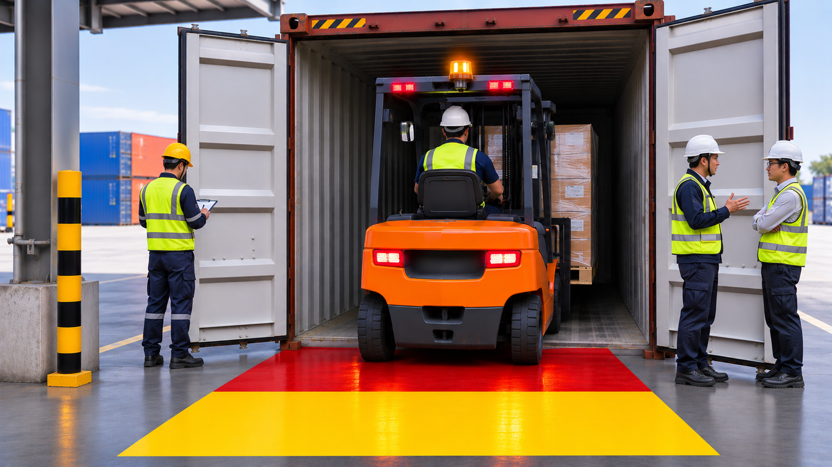
Yellow zone — automatic slowdown
When a pedestrian enters the warning zone, the forklift reduces speed automatically.
Red zone — automatic stop
When the pedestrian enters the danger zone, the system can command the forklift to stop.
The important difference is that the system does not rely only on an alarm.
The vehicle itself responds.
Actual stopping performance still depends on factors such as vehicle speed, load, braking performance, floor condition and forklift model, so the system must be tested and configured for the real vehicle and application.
When the Risk Is an Object
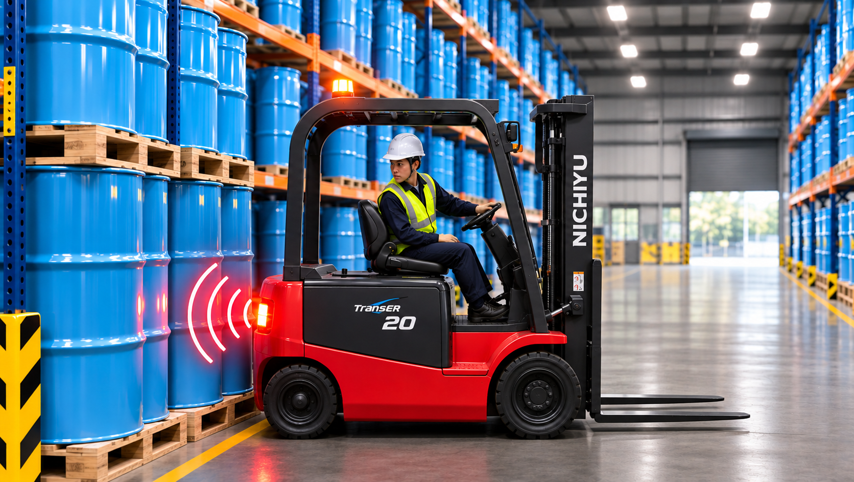
Not every accident involves a person.
Forklifts also reverse into racks, pallets, walls, columns and stored materials.
For this type of application, an AI camera may not always be necessary.
An ultrasonic sensor can measure the distance between the rear of the forklift and a nearby object.
As the forklift gets closer, the warning sound becomes more frequent.
This can be useful for reversing, parking and operating in narrow areas.
In this application, the system is designed to warn the operator about distance.
It does not need to identify whether the object is a person, pallet or wall.
That is why the correct technology should be selected according to the actual risk, not simply according to which sensor sounds more advanced.
What If the Area Contains People, Vehicles and Blind Spots at the Same Time?
This is where many real factories become more complicated.
A forklift may be operating in an area where:
- pedestrians are moving nearby
- other forklifts are approaching
- buildings or walls create blind corners
- several traffic routes intersect
If every detection causes the same response, the system can become impractical.
Stopping every time another forklift comes close may interrupt operation unnecessarily.
Giving only an alarm when a pedestrian is in danger may not be enough.
This is where UWB tag classification becomes useful.
Different tag types can be assigned to different risks.
For example:
| Tag Type | Detected Risk | Forklift Response |
|---|---|---|
| Person Tag | Worker carrying a UWB tag | Stop |
| Vehicle Tag | Another forklift or industrial vehicle | Slow down |
| Infrastructure Tag | Blind corner, doorway or fixed risk point | Audible warning |
The forklift can therefore respond differently depending on what it detects.
A nearby worker may require a stop.
Another vehicle may require controlled speed reduction.
A blind corner may only require a warning.
The same forklift can react differently as it moves through different parts of the site.
One Factory May Need More Than One Technology
A single forklift may face several different risks during one shift.
It may reverse out of a container, pass through a pedestrian area, approach another vehicle, travel through a blind intersection and park close to stored goods.
Those situations do not all require the same response.
AI Camera can be used to detect pedestrians without requiring tags.
UWB can classify tagged people, vehicles and fixed locations.
Ultrasonic sensors can detect nearby objects and help with reversing or blind spots.
The objective is not to install as many devices as possible.
The objective is to match the response to the actual risk.
Start With the Accident, Not the Sensor
Before choosing AI Camera, UWB or Ultrasonic, it is better to look at the accident scenario first.
Is the forklift hitting people or objects?
Does the incident happen while reversing or moving forward?
Is visibility the main problem?
Is the operator reacting too late?
Does the risk occur in an open area, narrow aisle, intersection or loading zone?
Does the application require only a warning, or should the forklift slow down or stop automatically?
These questions usually lead to a better safety design than starting with a product name.
From Warning to Intelligent Response
Forklift safety is no longer limited to lights and alarms.
The next step is to make the vehicle respond differently depending on the type of risk.
At Quick Autopart, AI Motion, AI Camera, UWB and Ultrasonic technologies can be combined and configured according to the actual site layout and operating conditions.
Because a pedestrian, another vehicle and a blind corner are not the same risk.
And they should not always trigger the same response.
Quick Autopart — Digitalized Forklift Safety