


AI Camera vs UWB vs Ultrasonic for Forklift Safety: What’s the Difference?
Choosing the Right Forklift Detection Technology
There is no single detection technology that is best for every forklift safety application.
AI Camera, UWB and Ultrasonic sensors detect risks in different ways. The right technology depends on what needs to be detected, where the risk occurs, and what response is required when the risk is detected.
At Quick Autopart, we begin with the operating risk and then select the appropriate detection technology and vehicle response.
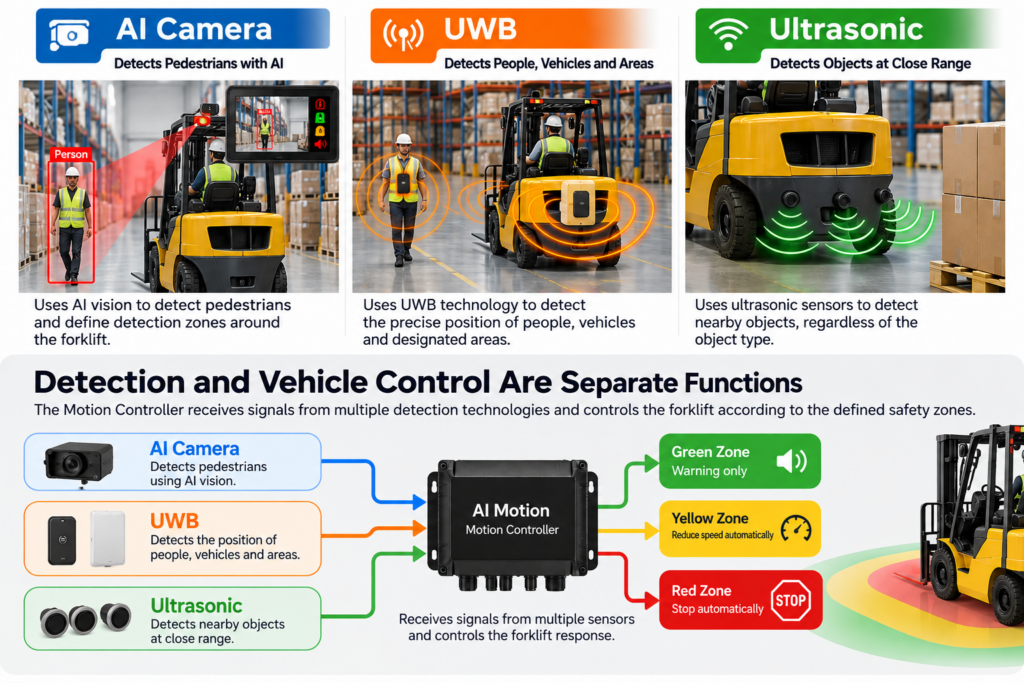
AI Camera: Pedestrian Detection
AI Camera uses vision-based detection to identify pedestrians around a forklift.
It is suitable for applications where the primary risk is a forklift approaching or operating near pedestrians. Detection zones can be configured around the forklift according to the operating environment.
When integrated with AI Motion and the Motion Controller, pedestrian detection can trigger different vehicle responses according to the configured safety zone, including automatic speed reduction or stopping.
Best suited for: forklift and pedestrian interaction, blind spots and areas where pedestrian detection is required.
UWB: Proximity Detection
UWB (Ultra-Wideband) uses positioning technology to detect proximity between equipped objects.
Unlike AI Camera, UWB does not depend on visual recognition. UWB tags can be used for pedestrians or forklifts, while defined areas can also be configured for location-based safety applications.
When integrated with the Motion Controller, UWB detection can trigger automatic forklift speed reduction or stopping according to the configured conditions.
Best suited for: tag-based pedestrian or vehicle proximity detection and defined safety zones.
Ultrasonic: Short-Range Obstacle Detection
Ultrasonic sensors detect objects at short range by measuring reflected sound waves.
They are useful when the requirement is to detect the presence or distance of nearby obstacles rather than identify whether the object is a person or another type of object.
Ultrasonic detection can also provide an input to the Motion Controller for automatic vehicle response.
Best suited for: short-range obstacle detection and applications where object classification is not required.
Detection and Vehicle Control Are Different Functions
Detection technology identifies the risk. Vehicle control determines how the forklift responds.
Quick Autopart’s Motion Controller can receive signals from different detection technologies, including AI Camera, UWB and Ultrasonic sensors. Depending on the application, the system can provide warning, controlled speed reduction or automatic stopping.
This allows the detection method and forklift response to be selected independently according to the actual operating risk.
Which Technology Should You Choose?
The choice should begin with the risk rather than the product.
If the requirement is to detect pedestrians without requiring them to carry tags, AI Camera may be appropriate. If reliable proximity detection between tagged pedestrians, forklifts or defined areas is required, UWB may be more suitable. For short-range detection of nearby objects, Ultrasonic sensors may be sufficient.
In some applications, more than one detection technology can be used with the same Motion Controller.
The objective is not to use the most complicated technology. It is to use the appropriate detection method and vehicle response for the actual risk.
For a detailed comparison of detection range, identification method and typical applications, see our AI Camera vs UWB vs Ultrasonic comparison.